Showing posts with label Buddipole. Show all posts

Sunday, December 21, 2014

Pouring Rain Outside, CW Inside in Straight Key Style

AK2MA Oregon Set-up
The many inches of snow changed over to rain overnight and its been pouring for most of the day. I decided that it would be a great day to get back on the straight key and attempt some QSO's. As I've mentioned, my portable set up is parked on the table with my Buddipole set up nearby. Not the best of configurations but it seems to work for my QRP efforts. (See photo)

I checked into the K3UK SKCC Sked Page and I was only there a short time when I received my first QSO request. I received several more requests and I was able to make good on all but a few of them. Since I'm running QRP with my indoor antenna, the other stations were doing most of the work. It was fun spending nearly an hour making contacts. Several I've worked many times over the years. I very much enjoy the SKCC Club and many a friendship has formed upon my joining their ranks. It's obvious that I was a bit rusty on the straight key and I needed to do some adjusting to my Navy Flameproof but I'll work the bugs out. By the end of the afternoon, I worked the following stations with my set-up; VA5CW, W2NRA, AA7WU, AA4H, KD8DEU, AH6AX, K4DJ, K6III, KZ5OM, WS1K and W6UT. East coast to west coast, 20 meters allowed me to have a bit of Morse fun today. One things for sure, I had no plans of spending time outdoors. 

My QRP, JT65A Saturday Effort and Snow!

Crater Lake Snow
Prior to moving to Oregon, I did a bit or research on weather. I still very much enjoy winter (my mother once told me, the older I get, the more I will dislike winter) and after 9½ years living in the Interior Alaska, I really never minded the bitter cold temperatures that I experienced. Even for the year or so we lived in central MA, we still saw cold winter temperatures with the coldest being about -19°F. I think the most snow I've ever experienced in my lifetime (till now) was the big Blizzard of 1978 in Ohio. When I began reading the average seasonal snow fall totals for Crater Lake National Park, I knew I was in for an entirely new experience. My wife was never a fan of the darkness during the winter months in Alaska, and certainly not the bitter cold -40°F to -50°F temperatures. So, this was a great compromise location to live. I could still enjoy winter, the days are much longer and the temperatures are much warmer. Marital harmony at last? Only time will tell. I do enjoy the much slower pace here over the east coast.  


JT65A on 20 Meters
Getting back in the shack saddle, I decided to fire up some JT65A on Saturday. My shack computer is packed away with the rest of our stuff in some storage building here in Oregon. I brought along our little Dell Inspiron Desktop computer which I loaded some ham radio programs onto. It suffers from the usual small computer configuration by only having one identifiable USB-serial port. This becomes a bit of a problem when you are trying to set up multiple programs to run at the same time and still want full rig control. I'm not really worried about it, as this won't be my main shack computer. I'm only putting software on this computer to get me on the air until we get settled and our stuff arrives. My Icom 703+ communicates fine, so sending and receiving JT65A signals work, I'm just not able to feed frequency data to the JT65-HF software when I'm operating. 


QRP JT65A
If you've read my previous blog, you will see my second story open concept shack layout. It includes internal Buddipole antenna, my Icom 703+ set up on the kitchen table (I do have an understanding licensed but non-HF operating wife) along with many other odds and ends. I'm manually logging QSO's at the moment but just started to load some logging software onto the computer. I still need to update my LOTW data to include this new location but I have time. It's time to get on the air and play a bit. Been a long several weeks. 

I tuned up the rig for 5 watts of output power and after setting up the JT65-HF software, I was CQ'n. I managed a handful of contacts and a couple answered but never came back. It was a successful first run of this mode here and I'm ready to move on to doing some PSK31 next.


More than just a rig's power setting...
One of the things with good weak signal software is some don't realize how much they can wipe out the band when running hot! There is more to running this mode than simply a power setting. When trying to copy weak signals (such as myself using an indoor antenna, as many are weak anyhow, depending on band conditions) it does not take much for me to lose a QSO if one of those hot running stations are nearby. And to top it off, the line you see just under -500 is my computer monitor. My widescreen is very nice but I'm unable to change the displays refresh rate in Hertz, so it's stuck at 60. Being able to change this setting could help eliminate this interference but again, this is not my shack computer so I need to deal with what I have. The screen also broadcasts numerous birdies across most of my bands. Sacrifices we sometimes have to make.


Heard and Being Heard
It's great to be able to see where you are being heard where you are hearing and how strong. The PSK Reporter website is a fantastic digital visual reference tool for any digital operator. Left is a screen shot of my Saturday operation (query ran today, Sunday). With the technology we have available today, it can sure help any operator understand propagation, adjust their rig settings and see the big picture. Obviously this would not be possible without the website owner and those who click their software checkbox to feed the data to the website. One of my other favorite digital reporting sites is HamSpots. HamSpots also allows for live operator keyboard interaction with the chat feature. 

My digital days are just getting started again and I hope to get on a few other modes as I get the software loaded onto this computer. My all time favorite is RTTY and I miss operating that mode, especially in contests. Hopefully as we get settled, I can put up a few exterior HF antennas and get back into contesting once again. With the holidays fast approaching, I'll have a few more days off to play radio. I'm hoping the bands cooperate and who knows, maybe I can bounce some weak signal JT65 off of Santa's ionized trail this week.  

Sunday, December 14, 2014

To The Rim, Finding My Grid Square And Then On To 20 Meters.

Crater Lake
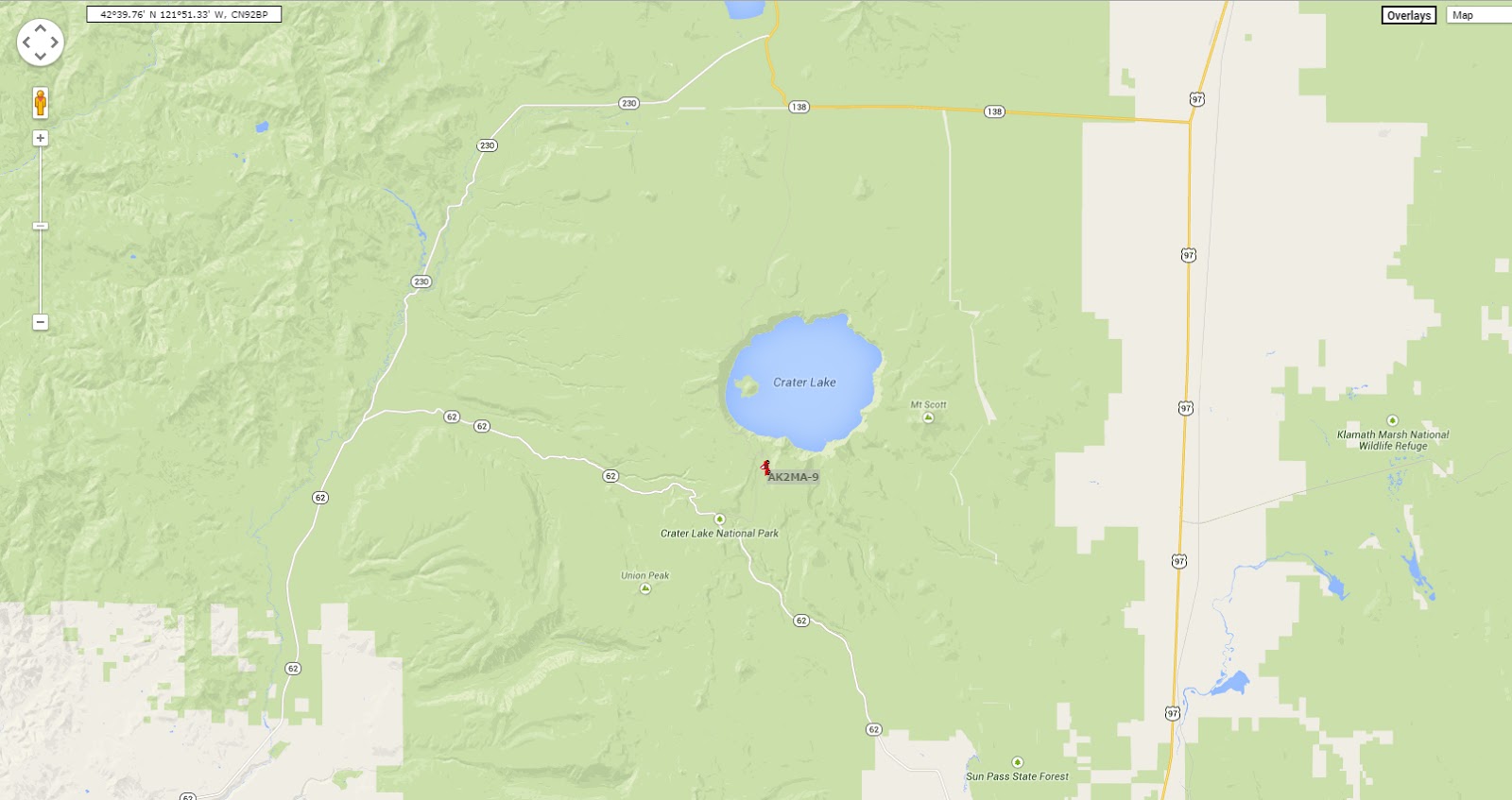
Since arriving to our new surroundings, the weather has been very overcast with rain in the lower elevations and snow up here in the higher elevations. Relocating to Crater Lake has one more check box marked on my bucket list. And when the sun finally came out on Saturday, it was time to go explore my surroundings. My wife and I made a morning of driving up to see what Crater Lake had to offer and she did not let us down. A breathtaking landscape surrounded by her mountainous rim. After taking lots of photos and hiking where we could (no snowshoes as of yet) we headed back to the house for lunch. Afterwards, it was time to break out the portable HF ham radio equipment to see what I would be able to hear.

CN82wv
First things first. I have been impressed with the APRS coverage here primarily due to the STUKEL Mountain Igate and KFALLS Digi relaying APRS data from up here at Crater Lake. As mentioned in my previous blog, I have an old Garmin GPS III in my truck that has been losing its memory (hopefully due to needing batteries replaced). I have a Garmin GPS III Plus that I use when I'm operating portable. I love the old Garmin units as they show our highly used Maidenhead Grid Square Locator. I'm not sure if there are any more modern units that do the same but I snagged a few of these a few years back on eBay just for this reason. I fired up my Garmin and set it in the snow bank in front of our residence and after finding the satellites, it was not long before I had my Grid Square! 

Internal Antenna Setup
I snagged my Buddipole out of its case and began to assemble the antenna. I ran this same indoor setup at our previous residence in MA, and it seemed to do pretty well considering. I had it set up in the 2nd floor hallway back there and thankfully, our current residence has an open floor plan on the second floor which works well for my current indoor setup. While at the Dayton Hamvention this past year, I picked up a few accessories from the Buddipole booth. I was excited to finally put them to use. 

Assembly went well and before I knew it, I had the antenna ready to be hooked to my Icom 703+. Since most of my equipment was still in storage with the moving company and many of my tools were in the tool compartment of our camper, I only realized my oversight when I was ready to tune the antenna. You see, I wanted something smaller than my MFJ-259B to use when I was portable. For obvious reasons, the MFJ uses a Kazillion batteries and it's very easy for the power button to be depressed when you are carrying it in a backpack. It's saddening to find out your MFJ has no life left by the time you get to your operating location. Been there, done that.

IP60z
Enter the iP60z Portable Antenna Analyzer! I looked at a few small analyzers while at the 2014 Hamvention and after talking with my friend Steve, wG0AT at Dayton, I opted for this model. Ironically, my mini screw drivers and 9 volt batteries were back in our camper which was about an hour away from our residence. So, for my Saturday operating, I would have to resort to tuning the antenna the manual way. Having an antenna indoors makes tuning an antenna a bit more challenging so I was hoping to have my iPortable analyzer to help me. That now would not happen until Sunday, when I made the trip to get batteries and screw drivers (I now have a dedicated set with my portable gear box). 

Anyhow, I was able to tune my Buddipole antenna indoors and I first listened to 10 meters. More irony as the first station I heard on 10 meters happened to be W1NA, in my old state of Massachusetts. But signals seemed low and not that strong but not uncommon with indoor equipment. Since this was the first time I had set up the equipment here, I've not had the time to grasp what normal propagation sounds like from this location. After listening to 10 meters for a bit, I jumped up to 20 meters where I originally tuned the Buddipole.

J-37 Straight Key with Icom 703+
It was so nice to once again hear the activity on the ham bands and be decoding Morse Code (CW). My main focus was to make a few contacts in the SKCC Weekend Sprintathon. Thanks to Curt, WA2JSG for posting reminders to Facebook! I enjoy manually sending code just about as much as I enjoy higher paced CW contests. No records broken here and I only logged a few manual contacts with my first being Tony, K6ELQ. Tony was very strong (in California) so it was an easy QSO for me. I followed up by working Ed, W7GVE in Arizona, John, K0AE in Colorado, the power station Ted, K8AQM in Michigan and finally, Brian, WB4IT in Alabama. Not bad I guess, considering my indoor antenna and rig set at 10 watts. When I checked the antenna SWR on Sunday, it was a bit high (see iPortable photo above) so in all reality, I was nearly QRP.

Drivers Seat
Even though I only made a handful of QSO's, it was great to finally get on the air from my new QTH. My goal is to get on the air more frequently, especially since I won't be stuck in a vehicle for several hours a week commuting to and from work. That can now be transferred to radio time! But I still have plenty to do yet as we continue to get settled at our new location. I'm hoping this will be the last move for a very long time. Now to work on finding a place where I can put something more robust together and get back into contesting. Not that it can't be done with my current set up, but I prefer external antenna's and computer aided contesting accessories (again, all of which are in storage at the moment). 

Digital JT65A
Taking a bit of a break from listening to CW, I hooked up the mini laptop to decode some JT65A. It took me a bit to get the laptop tuned and the clock set for decoding but it was not long before I was seeing stations populate my software screen. I made sure I was uploading my reception reports to PSK Reporter and it was fun to see how far away I was hearing with my indoor set up. I decided to just decode and not attempt to work any stations. Again, getting acquainted with the propagation in this neck of the woods is my first strategy. I believe there was a bit of solar activity this weekend that did not help but at least I know I can make contacts! 

PSK Report for AK2MA
I would classify my Oregon maiden voyage onto the ham bands a success, although not earth shattering. As time allows, and now that I have a battery in my iPortable iP60z, I plan to get on as often as possible and play on the HF bands. I will tune the antenna for the best SWR possible and make my first QRP contacts. Because my antenna is indoors, I have no desire to run anything more than what my Icom 703+ will exhaust. My Yaesu FT-857D will remain in it's box until I get outdoors and do a bit of portable operating from some local vantage point. 

AK2MA
Since we won't be going any where for the holidays and we are across the country from our families, I expect the next few weeks will allow me to spend even a bit more time than normal on the bands. Straight Key Night is not far away and since I missed it last year, my plan is not to miss it this year. There is just something exciting about communicating using one of the oldest forms of communication. Since that first message in 1844, it's still a very popular way to communicate. Even with all the high tech forms of communication we have available to us at this time, just listening to any contest weekend will make you realize that Morse Code is far from extinct. And manually sending Morse Code to me is like driving a car that has the high beam switch on the floorboard, a separate key for the trunk and an 8-Track radio!  Okay, maybe a crude comparison but you get my point. Either way it's fun and it's certainly nice to be back in the game!


Thursday, December 11, 2014

APRS Broadcasting and Life Over 3,200 Miles and 6,300 Feet Later

AK2MA-9 now in 7'Land
Seems I've been having issues with my old Garmin GPS III lately. I use it to feed location data to my Kenwood TM-D700A while mobile. In a recent cross country trip, I was able to troubleshoot the issue with the help of my long time friend and APRS Guru Sean, KL1SF. Once we get settled, I need to replace it with a spare GPS III that I have or my V if the issues continue. I like the GPS III as it does Maidenhead grid location so it works great as a mobile unit if you want to work some HF/VHF and need your grid square. I was only able to broadcast my location during the final third of our trip due to my GPS III losing memory data.

With that said, there has been very little time for ham radio over the last several months. A career move to 7'land has landed me at our new QTH. The cross country trip went extremely well and the weather cooperated for all but the beginning of the adventure. But I am temporarily settled and I'm looking forward to getting my portable set up working here in Oregon. I think the elevation should hopefully help my QRP signal and I'm looking forward to once again hearing those strong Pacific signals that I used to hear when we lived in Alaska.

Having worked at sea level for the last year or more has me moving a bit slower at this higher elevation. Once I get on the air, it may take a week or more for my CW to get back up to speed. Primarily due to the lack of oxygen getting to my brain that passes those dots and dashes to the straight key through my upper extremity. I'm sure my decoding skill will be effected as well but probably due more to being inactive for the last several months. The time I spent commuting to and from work in Boston can now be used for the HF bands. 

Now starts the tedious process when one relocates with all the changes that need to be made. But one thing never changes, my love for the hobby and Morse Code. My equipment is still in my camper but my plans are to bring it all up here this weekend. With any luck, I will have my Buddipole antenna out of the bag and sending and receiving radio signals on the HF bands once again. My wife has been warned, it won't be long before coax is once again strung through the house and the sweet sound of CW will be heard throughout. Stay tuned for photos and propagation reports.   


Sunday, June 15, 2014

Dayton 2014 Part 2

My 2014 Dayton Purchases
My purchase moments while at the Dayton Hamvention® are those items you see in my photo to the left. My main planned purchase was going to be a portable antenna analyzer that could be easily carried with my current Buddipole setup. MFJ had one I was extremely interested in but I ended up with the iPortable IP60z. The early reviews on this unit were not very favorable but I know a few who have tested it with good results. So, I opted to purchase it. Things I like, this little unit covers the HF bands plus 6 meters. It is powered by a 9 volt battery so carrying a spare will keep me from finding it useless miles from the truck. And finally, the size and portability of the unit. I have the BIG MFJ analyzer but this will at least help me tune my portable antennas in the field. When you are running QRP, you want every watt to count. 

Peanut
Next is my Buddipole Choke Balun which will help keep any unwanted RF from traveling down my feedline. I do on occasion run more power than QRP so this should help keep my audio from sounding funny and my rig from glowing. I purchased both from the Buddipole booth at Dayton. The highlight was purchasing these items from Steve, wG0AT. In 2010, I had some work related training in MO. My wife and I flew into MO and afterwards, we hit Ohio to visit friends and family. From there, we headed out to Colorado for a few days on our way back to Alaska. I had dropped Steve a note asking if it was okay to stop by. Steve gave us the thumbs up after getting approval from Rooster (SK) and Peanut. It was such an honor to spend a day with Steve and the goats climbing Mount Herman! Steve did a great video of our operation and I have to say, I was bitten by the QRP bug from then on! Thanks, Steve!!! I detailed a bit on my KL8DX blog

My final purchase was the interface and software by rt Systems which will allow me to easily program my Kenwood TM-D700D radios. I can now keep everything on my computer and when traveling to various locations easily upload my saved frequency information for various repeaters and simplex frequencies. Sean helped me decide on this purchase so it came highly recommended. 

Now, hitting Dayton was extremely memorable but it was great to finally put faces with callsigns. It was a pleasure to finally meet the BIG HAMMER himself, Tim KG8OC. With Tim, was his wife Sandy (KB8WJT) so it was a pleasure to meet her, too! Also highlights were finally meeting Karen, W4KRN and Curt, WA2JSG. Like Tim, I got to QSO with those two pretty frequently when I was in Alaska during SKCC events. Also with Curt, was Jim, K8SSS who I also worked a few times on the straight key while I was in Alaska. 

Through Facebook, I set a sked with Craig, NM8W. I used to work with Craig's cousin back in Ohio. Also, it was finally great to meet up with Warren, VA3UG. I've worked them on the bands as well and it was sure great to spend a bit of stadium seating time with them. Craig had his son with him so I bet there is a future ham in that household!

Grand kids
After Dayton, we made a quick trip up to see or daughters and grand kids. The advantage of being many thousands of miles closer is being able to see our grandchildren more frequently. You can sure bet I will introduce them to ham radio when it's time. The trip seemed short but it was extremely fun. I didn't get to do all that I wanted to but there hopefully will be future trips. I'm going off of memory as to those I met so hopefully I'm not forgetting anyone. 

The culmination to our Dayton adventure was the Dayton Contest Dinner on Saturday night. Sean. KL1SF and I sat with a few of the Alaska group. It was great to meet Kevin, KL7KY! I've heard Kevin on the bands for several years so it was nice to actually chat with him off frequency and meet him. Kevin was accompanied by Jeff, KL7JVD and Tim, KL7WV (aka W3YQ). Tim and I have a mutual Buckeye State connection, Dan W8CAR. I actually ran into Dan after Contest University so it was great chatting with him, too. 

Of the Alaska group, I had my eye out for Rich, KL7RA. Rich invited me into the Alaska contest group shortly after I had arrived to the 49th and with their help, I was able to dive into contesting and never look back. Being affiliated with the group really helped me grow as a contester. I wanted to finally meet Rich and thank him personally for helping me and also for allowing me to be part of the best group of contesters I know. Mission accomplished! I owe much of my success to them and for that, I will be forever grateful. 

My APRS Alaska Departure
It's hard to believe that a year ago, I was on my way to the East Coast. The APRS map shows my final packets sent while leaving Alaska. I think about Alaska often and sadly, I have not made a contact in many weeks! Life is just so busy here and with long commutes, long work weeks and short weekends, it feels as if there is no time for ham radio. My weekends are booked for the next few months and I'm looking forward to putting to use those items I purchased at Dayton. Yes, they are still in the bag I brought them home in. Rest assured, operating day will come again but for now, I will throw out an APRS packet burst from time to time. That will be the extent of my operating but if I can pull out a few minutes on a nice weekend, I'm looking forward to some /p operating. Could be wishful thinking but only time will tell, or that lack of...       

Saturday, March 29, 2014

JT9 Transmitted & Received

First JT9 QSO
My very first QSO on JT9 was with PA3FOE just a few minutes ago. Success! I was running my indoor Buddipole antenna with my Icom IC-703+ at 4 watts. Since I was logging with an older version of Ham Radio Deluxe (HRD) Logbook, I had to add the mode as it was not in my drop down menu. Once that was added, in the logbook my QSO went. Not a bad start but I'm finding the bands less than favorable today (Saturday). Obviously, this is when software generated weak signals modes will shine. Roughly a 3,500 mile QSO from MA to the Netherlands. Also, my Buddipole is being a bit stubborn today tuning the different bands. Or maybe the coil taps (clips) are bit more challenging for my ageing eyes today. Running a Buddipole indoors is a bit more challenging to tune (obviously) as there is plenty to effect the SWR

Sunday, March 23, 2014

Bouncing Around the Globe, QRP Style.

TV Tray Set-up
This weekend was yet another JT65A weekend for me. I saw that 10 meters appeared to be active so on Saturday, I set the Buddipole up for that band. It was not long before I was decoding some very nice signals out of Europe. My first QSO came shortly after 1800z with OK1JKV. I was running 3-5 watts all weekend, not exceeding my band defying QRP wattage. And as the sun progressed westward, the propagation did as well. I copied several stations that I would have loved to have a QSO with but a few of the signals were just a bit on the light side. Strong enough to decode but at -24dB, there was not much hope for my JT65A QRP signal with the others also calling the same stations I had an interest in.


Close but No Cigar
One of the exciting moments for me over the weekend was when I saw that VK2QQ answered my CQ. I was elated to finally hear and possibly work into VK'land! Sadly, that's as far as the QSO went. I went back to VK2QQ a few times with no luck. So, it was close but no cigar! I know that I will have future opportunities and if anything, I now know when to start listening. Actually, if it were easy, it would not be as much fun. If you click on screen shot to the right, you will see that VK7DZ was also working stations and I had a copy on a QSO a few minutes earlier from that station. 


QRP 3 Watts
As I've mentioned so many times blogging over the years, 10 meters is my favorite band. You just never know where it will take you when the band opens. You can work the band with pretty much any antenna with great results. Novice Enhancement opened up 10 meters to hams years ago and it's been a great watering hole ever since. It was one of the first bands I really cut my teeth on and some of the best DX I've worked has been on this band. The other advantage to this band is that it's very broad, running from 28.000 on up to 29.700. There is plenty of room to have fun no matter what mode you prefer to operate. 


AK2MA Table Top DX Station
With the weekend still pretty busy, I was able to let the JT65HF software decode and keep an eye on the band as I went about my other weekend activities. When I'm not operating, I will try to leave the software so that it uploads what I'm hearing. When I'm operating, I also like to see where I'm being heard so I keep my iPad handy connected to hamspots. It's always very interesting to see how well I'm being heard in various directions and by which stations. My little corner of the kitchen is just that, little. But for now, it suits me just fine. As I ponder the thought of permanently downsizing my station, I'm trying to put together the best small station that I can. I've been impressed with the 703's ability on the digital modes. It's obviously not my 756PRO but it's a great compact rig. 


DK2HX Indoor antenna to indoor antenna
When I logged into eQSL I had several cards waiting for QSO confirmation. One of which is pictured to the left. This was a bit unique as both Heinz and I were running indoor antenna's according to his comment at the bottom of his QSL card. Heinz was running 8 watts to his indoor magnetic loop antenna and I was running 5 watts (actually a tad less) with my indoor Buddipole. So, a perfect example what is possible when the band is open. A QSO over 3,500 miles away with a few watts feeding into indoor antenna's, both ways. With some good weak signal software and the right propagation, DX easily falls into the logbook just as it did for me this weekend. I'm hoping to venture on to JT9 here soon as well. I've heard a few hams mention it. That's the grand beauty of this hobby, there is something for everyone! 

Sunday, March 16, 2014

Understanding My Propagation and Work'n a Few QRP

PSK Reporter Map for AK2MA
My personal schedule has been pretty busy over the last few weekends but I wanted to get on and play a bit this weekend. My goal was to get back on JT65 and work a few stations. Saturday was out of the question but I was bound and determined to get the indoor Buddipole hooked up to the IC-703+ on Sunday. I actually did get things hooked up late Saturday night and just let JT65 send reception reports to the internet while being parked on 20 meters.

Alaska
One of the great uses of weak signal software like JT65HF of WSPR (just to name a few), it allows you to study propagation patterns to and from your QTH. This is a great tool when you are looking for a certain section of the globe that has evaded your logbook. I have to think back to the days when there was no internet and to work a new one, you either monitored the local packet cluster via AX25 Packet, received a phone call from a fellow ham or just happened to stumble across that new one. How did we survive? Call me crazy but I actually miss those days. 

Japan
Using PSK Reporter, I was able to determine what I was hearing and when. Doing a bit of homework will pay off if you study how propagation works. Of course, there is a bit more to it, but understanding when a certain part of the globe might be heard from your QTH is a great start. I recently read a blog entry from KL2R that hit this subject directly. Larry outlined some great advice. Not that each and every ham needs to be a propagational expert (I'm far from being one) but it pays off when doing your homework. It's extremely helpful to know what you might hear when surfing Grey Line Propagaton or simply which band might be the best to use during a certain time of day or night. Beacons are another great tool. NW7US writes many articles explaining propagation and routinely writes predictions for upcoming major contests. It's extremely easy to drop an email and ask for a sked but you might be surprised what you can work if you put in a little bit of research. Of course, there are many factors that effect modern day communications but the more you understand, the better your chances of success.

JT65A & 15 Meters on Sunday, March 16th, 2014
And in speaking of success, I knew that 15 meters should yield some good propagation across the pond for my compromised setup. My setup is far different than what I had in Alaska. I'm currently running (on pretty much a regular basis) my Icom IC-703Plus at 5 watts or less to my Buddipole Deluxe set up in our upstairs hallway. Because I'm running QRP and using an indoor antenna, it can be a struggle to find my next new DXCC entity or that new state. I'm currently working on QRP DXCC both on the CW and digital modes. It's tough at times but easily attainable. Running QRP requires lots of patience and I'll be the first to admit, I lack in that arena. But as mentioned earlier, homework and persistence will pay off so I know I'll be successful.

Indoor Buddipole Setup      
I've had a few inquiries in regards to my indoor buddipole configuration. The picture to the left gives a view of my Buddipole Deluxe as I routinely set it up in the upstairs hallway. Running QRP, it's crucial that the SWR is as low as possible as I want as many of those few watts to make it to the antenna as I can get. It also helps that the antenna is on the second story so it's approximately 20-25 feet above the ground. Still far from anything great but as you can see, you don't need much to get on the air. As I've mentioned before, after running beam antenna's and power over several years, this has been a humbling experience for me. I set up the Buddipole using the suggested configuration (depending on band) and normally it will get me in the ballpark, even indoors. 

For now, this is my station but I'm thankful to be able to get on the air. I'm not sure when and if I will ever have a full station with exterior hardware on the air but as hams have proven over the years, where there is a will, there is a way. In the mean time, I'll continue to surf the propagational wave of DX in hopes of landing that next new one bringing me closer to that very meaningful certificate I hope to collect. Just like the lottery, you can't win unless you play.   


Saturday, March 1, 2014

Interface Cable Located! Now the Fun Begins.

First Night of PSK31 on Indoor Buddipole & IC703+
Moving is never fun and it just so happens that things get lost or misplaced. I opened up our travel trailer today to see if I could locate my Icom interface cable that I used with my IC-703+. I came up empty but I did get a few things out that I needed. I was bound and determined to hunt it down. I knew it could not be far but I was concerned as I had opened up and unboxed all shack contents. I checked and double checked in several mothballed equipment boxes but nothing. I was stumped.

It just so happens that I carry my Icom IC-703+ and related equipment in a small, deep plastic pistol case. A cheap Walmart knockoff of the Pelican cases made by Plano. I checked my case a few times with no success. I decided to pull everything out of it today and whaa-laa! I found it in the very bottom of the case underneath the foam padding. I figured I had it close but I was just not looking in the right place.

I got everything hooked up and decided to run a bit of JT65, however my clock was always off by more than 8 seconds! Normally such issues were caused when I would utilize Google Chrome or browsed in the background. Since this timing issue was normally indicative of browser use, I closed down everything except JT65 and of course, Dimension4, for the clock sync. Still it would always be 8 seconds off so needless to say, I was not decoding anything. I had it working just fine in Alaska, so something had to of changed. I decided to run PSK31 instead.

I had my Buddipole tuned for 10 meters but I parked on 20 meters in receive only mode for PSK31. I was using HRD's DM780 to decode and upload the spots or my reception reports. The map above is what I was hearing on 20 meters today on my indoor antenna. 

I had posted a tweet regarding my clock issues and thankfully Karen, W4KRN reminded me that the program needed to be run as an Administrator in Windows 7. Sometime during one of my numerous Windows updates (I normally shut off updates on ham computers as updates lead to more hair pulling and heartburn than what they are worth) something must have changed. I checked and sure enough, it was not running as Administrator so once I checked that box, things were back to where they were before I departed the 49th. 

IC703+ Connected to Mini Dell running DM780
I'm excited for this interface cable find as running QRP I can start taking advantage of some of the weak signal software to gain some new countries and states on the bands. The small screen on my Mini Dell can be an issue with some programs but JT65 has a small GUI version built right in, so it does a great job. DM780 can be a challenge but I'm hoping to grab some more software and start playing. I will be running WSPR on weekend nights in receive only mode just to get a grip on propagation in these parts. There is a new JT mode I want to try as well. While many are participating in the SSB contest this weekend, I will be playing around on the digital modes getting things set up. From HELL to RTTY, I'll be stalking digital signals and possibly working a few, too.       

Monday, February 17, 2014

2014 ARRL DX Contest. What a Difference 3,250 Miles (Over 5,000 Road Miles) & 95 Watts Make!


ARRL CW DX Contest 2014
This past weekend was the ARRL DX Contest, CW version. This contest has always been one my my most favorites, second only to the CQ World Wide DX Contests. The ARRL DX Contest has stateside stations looking for DX and DX stations looking for stateside stations. I decided on Friday to make my first limited QRP effort in this contest. I knew that my weekend schedule would not accommodate more than a part time effort but I wanted to take the plunge. Since I was going to be running my Buddipole antenna indoors, I wanted to just concentrate on a single band effort. This way, I could tune the antenna and leave it for the remainder of the weekend.


Getting it Close
I set up my antenna on late Friday night. When it's set up, it resides in our upstairs hallway. Not the best setup but since it's winter, I have no desire to put it outdoors. Besides, this seems to work pretty well considering. I was able to get the Buddipole SWR actually flat! I found that when I rechecked my match on Sunday morning, things were very different. It may be been bumped by another household occupant so I had re-tune Sunday morning. I was able to get it down to what you see in the photo to the right. I could not imagine trying to tune any antenna without a good meter. Matter of fact, I'm in the market for a smaller, portable meter to use in the field. I like my MFJ but it uses plenty of batteries and it's not the smallest to tote around. Since I will be doing more /P operating down here, I want something backpack friendly.

I landed on 15 meters ready for my Search & Pounce (S&P) effort just before 1700z on Saturday. I found the band to be in great shape. Such good shape, I started the contest at 1 watt output from my IC-703+. It was great hearing so many European stations so darn strong! 
I began at the bottom of the band and slowly worked my way up.


Search & Pounce QRP Style
It was obvious the band was loaded and many of the stations had pile-ups, which is typical during the first part of the contest, I opted to bump my power up to the full 5 watts after my first 10 or 15 QSO's. On a quiet band, my 1 watt may have worked but with the crowd, I was easily pushed to the sidelines and not heard. As I encountered many a new country, I had to make a mental note and tell myself that many of them would have to wait until Sunday. As I slowly worked my VFO up and down the band, my contest log began to slowly add points with a bump in the score adding the occasional multiplier. I wanted to document a bit of my QRP activities so I kept the Samsung S4 handy for a few videos. Below is the video I shot of me working F6KNB with my rig set at 1 watt. I worked F6KNB approximately about 5 QSO's into the contest (for me).


QRP is bittersweet. It's often a struggle for both the station running QRP and then for the receiving station. Some who are in contest mode won't take the time to work with a QRP signal meaning any more than one repeat, they are moving on. It's a contest, so expect a level of aggression. Since I enjoy QRP, I always made sure I would listen for the little guy when I ran as KL8DX. Now mind you, in a large pile-up, you take the loudest first and work your way down the calling list. But there are those times when timing is everything! Yes, it's possible to sneak that weak call in between BIG stations calling and be heard. A good operator will take the time to make sure they get the call and exchange correct. I have to hand it to SN5X (and several others, but I only got a few on video) for taking the time work me and get our exchange right. The video below is of me working SN5X on ½ watt!


Walking the VFO up the Band

As the afternoon progressed on Saturday, I worked the contest until around a bit after 7 pm local, or midnight UTC time. I threw in the towel until the following morning due to those "other" obligations that tend to arise over contest weekends. By the time Saturday came to an end for me, I had worked roughly 48 stations. Again, to the average ham, that's obtainable in the first sixteen minutes at 3 QSO's per minute. But I was a happy ham due to the fact that as the propagation swung west from Europe, I worked several Central & South America stations not to mention those enjoying their winter getaway down in the Caribbean. But the highlight for me on Saturday evening was working JF1NHD and KL7RA.

KL7RA has a great station and I knew that if I was going to hear an Alaskan station in this contest, it would surly be Rich's station. I captured the next video showing how strong Rich's station was here both on Saturday night and on Sunday as well.


So again, my Saturday ended on a pretty positive note. I was hoping that Sunday would see the same great propagation allowing me many more QSO's. 

2014 Winter in New England. More on the way!
As I mentioned earlier, New England has seen a pretty snowy winter. I'm actually enjoying working outside doing my snow relocation activities and it's well above zero! I loved Alaska but plowing and shoveling snow at -30F can be a bit rough at times. So for me, this winter has been easy. Now, we have received more snow here this winter than we would normally see at Denali. Our snow in Alaska was normally very dry and light but this snow, especially this last storm dump, had some weight to it. Anyhow, a large part of my weekend duties was clearing the driveway, walks, decks and of course the beagle roaming area. We have a 14½ year old beagle and when there is more than a few inches of snow, I plow a large spot in the yard just for her. I'm sure she is also enjoying the warmer temperatures as well, especially since she has to do her business outside. 

Getting back on track, Sunday turned out to be great on 15 meters as well. I was back on the air shortly after 1100 UTC once again working my way up and down the band. On Sunday, I heard contest stations working as high as 21.138! I had several stations which were strong but I could just never get their attention. In one case, I was trying to work E7DX and I apparently had a little helper. You know the station, the DX station was trying to confirm my call and for what ever reason, he was having problems copying it. It was either due to my low power or adjacent QRM. Either way, I heard another station telling him what my call was! It was either a impatient station wanting to get me out of the way so they could work E7DX or someone who felt they were doing the right thing, which they weren't. 

By the time it was all said and done, I made 150 QSO's and worked 57 countries (entities). I used N3FJP's software which gave me a nice overview of my country breakout -

AK2MA's Contest Summary Report for ARRL-DX
 Created by N3FJP's ARRL International DX Contest Log
 Version 3.4  www.n3fjp.com

 Total Contacts = 150
 Total Points = 25,650

 Operating Period: 2014/02/15 16:53 - 2014/02/16 23:28


 Total Contacts by Band and Mode:

 Band       CW   Phone     Dig   Total       %
 ----       --   -----     ---   -----     ---
   15      150       0       0     150     100
            --   -----     ---   -----     ---
 Total     150       0       0     150     100


 Total Contacts by State \ Prov:

 State       Total     %
 -----       -----   ---
               147    98
 HI              2     1
 AK              1     1


 Total Contacts by Country:

 Country                      Total     %
 -------                      -----   ---
 Federal Republic of Germany     14     9
 Italy                           12     8
 Poland                          10     7
 Croatia                          7     5
 Czech Republic                   7     5
 Spain                            7     5
 Serbia                           6     4
 Slovenia                         6     4
 France                           5     3
 England                          4     3
 Hungary                          4     3
 Aruba                            3     2
 Bosnia-Herzegovina               3     2
 Brazil                           3     2
 Finland                          3     2
 Netherlands                      3     2
 Ukraine                          3     2
 US Virgin Is.                    3     2
 Belgium                          2     1
 Canary Is.                       2     1
 Estonia                          2     1
 European Russia                  2     1
 Hawaii                           2     1
 Japan                            2     1
 Slovak Republic                  2     1
 Switzerland                      2     1
 Alaska                           1     1
 Antigua & Barbuda                1     1
 Argentina                        1     1
 Asiatic Russia                   1     1
 Austria                          1     1
 Bahamas                          1     1
 Balearic Is.                     1     1
 Belarus                          1     1
 Bermuda                          1     1
 Bulgaria                         1     1
 Cayman Is.                       1     1
 Colombia                         1     1
 Costa Rica                       1     1
 Curacao                          1     1
 El Salvador                      1     1
 Grenada                          1     1
 Jamaica                          1     1
 Kazakhstan                       1     1
 Latvia                           1     1
 Lithuania                        1     1
 Luxembourg                       1     1
 Madeira Is.                      1     1
 Morocco                          1     1
 Nicaragua                        1     1
 Portugal                         1     1
 Puerto Rico                      1     1
 Saba & St. Eustatius             1     1
 Scotland                         1     1
 Sweden                           1     1
 Turks & Caicos Is.               1     1
 Uruguay                          1     1


 Total Contacts by Continent:

 Continent   Total     %
 ---------   -----   ---
 EU            114    76
 NA             16    11
 SA             10     7
 AF              4     3
 AS              4     3
 OC              2     1

My goal is to submit for the QRP ARCI's 1,000 Mile Per Watt Award. Going into this contest, that was going to be one of my main goals. Without plugging in the numbers, I think my QSO with SN5X or IR4M would be in the area of 8,000 Miles Per Watt. Several of the stations I worked with 1 watt would also easily qualify, too. 

I uploaded a few more videos to my YouTube page and one highlights the coax run from the QRP kitchen set up to the Buddipole antenna in the upstairs hallway. We are still organizing so the clutter will hopefully be short lived. The coax runs from the kitchen, through our living room and up the stairs into the hallway where my Buddipole was standing proudly. 

I posted my first 3830 summary with this contest. I've sent my log in to the ARRL but still need to upload it to LOTW after importing it into my regular logbook. I'm hopeful many will be confirmed electronically. Any that are awaiting confirmation on eQSL will be confirmed on my next log in. 

All in all, it was a humbling experience being on this end of the pileup. Lots of great operators / stations and I had a blast. The only thing that would have made it better was being able to use my Mosley TA-34-XL for the high bands. I would have surely ventured off of 15 meters as I see on 3830 that the propagation on 10 meters was pretty good as well. Hopefully I did not bust many callsigns and there were a few questionable contacts so I opted to not put them in the log. If I did not hear the confirmation that my information was received, I did not log it. The only problem I had was several missed the "A" in my callsign and heard me as K2MA. As always, I attempted to correct the DX station and I think only a couple may have been too busy to correct it. 

As far as the weather is concerned, we are under another Winter Storm Warning for Tuesday. Seems another 4-6" of fresh snow headed to my QTH. Thankfully, I still enjoy winter so it's no big deal. That added to a bit of QRN as our transformer was busy causing me interference with the snow and wind that we encountered this past weekend. With my indoor antenna, I no longer have to worry about Mother Nature, just the other occupants of our residence. As for the family beagle, she spends most of her day sleeping so she is no threat to the indoor antenna. Other than the occasional walk by, contest weekends to her are something she is used to. She knows all to often that I won't finish anything I'm nibbling on so she gets what I don't finish. The photo below is of our beagle since I switched to drinking decaf.

Contest Dog